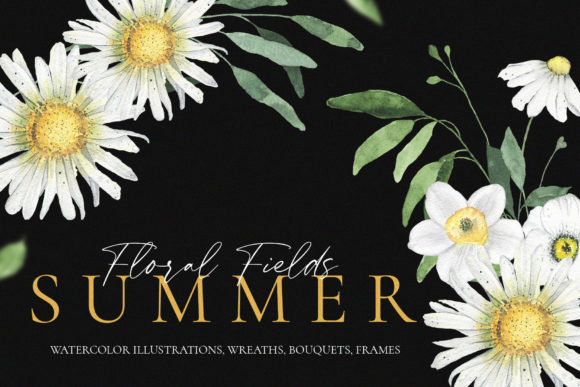
Evaluating the Summer Floral Fields Collection for Professional Design Projects
For graphic designers, stationery creators, and branding specialists, selecting the right visual assets is a critical step in the production workflow. The choice between vector-based illustrations, photographic stock, and hand-painted digital elements often dictates the final aesthetic and emotional resonance of a project. The Summer Floral Fields Collection represents a specific niche within this landscape: a curated set of hand-drawn watercolor flowers and green leaves designed to bring an organic, artistic touch to various media. Understanding where this collection fits within the broader ecosystem of design resources requires a practical look at its format, versatility, and how it compares to alternative approaches.
Defining the Aesthetic and Technical Specifications
The core value of the Summer Floral Fields Collection lies in its medium. Unlike crisp, geometric vector graphics or hyper-realistic photography, these illustrations mimic the texture and fluidity of traditional watercolor painting. This style is particularly effective for projects requiring a sense of warmth, authenticity, and handmade charm. The collection includes 61 individual elements ranging in size from 756x3135 px to 2752x2746 px, alongside 10 pre-arranged bouquets, 10 frames, and 10 wreaths, all provided in high-resolution PNG format.
The technical specification of 4000x4000 px for bouquets and 5000x5000 px for frames and wreaths is a significant differentiator. In the world of digital assets, resolution often determines utility. Many free or low-cost clipart sets offer images at 72 DPI or resolutions too low for professional printing. By providing files at this scale, the collection bridges the gap between web usage and high-quality print production. This allows designers to use the same asset for a social media post and a large-format wedding invitation without worrying about pixelation or loss of detail.
Comparative Analysis: Watercolor PNGs vs. Vector and Photo Alternatives
When evaluating the Summer Floral Fields Collection, it is helpful to compare it against the two other dominant categories of floral assets: vector illustrations and stock photography. Each approach has distinct tradeoffs regarding editing flexibility, file size, and visual impact.
- Vector Graphics (SVG/EPS): Vectors are infinitely scalable and allow for easy color manipulation. If a project requires changing a flower from pink to blue instantly, vectors are superior. However, they often lack the textural depth and organic imperfections that define the watercolor style. The Summer Floral Fields Collection sacrifices infinite scalability and easy recoloring for a richer, more painterly aesthetic that vectors struggle to replicate authentically.
- Stock Photography: Photos offer ultimate realism but can feel sterile or overused. They also present challenges when integrating with text or other graphic elements due to complex backgrounds and lighting inconsistencies. The hand-drawn nature of this collection provides a stylized look that integrates more seamlessly into layouts, particularly for branding and packaging where a cohesive illustrated identity is preferred over a photographic one.
- Low-Resolution Clipart: Many affordable options online suffer from poor resolution and jagged edges. The high pixel density of the Summer Floral Fields Collection positions it as a professional-grade resource, suitable for commercial applications where quality control is paramount.
Versatility Across Use Cases
The utility of any design asset is measured by its adaptability. The Summer Floral Fields Collection is structured to support a wide array of applications, from wedding invitations to digital branding. The inclusion of both individual elements (leaves, single blooms) and composed arrangements (bouquets, wreaths, frames) offers a spectrum of workflow efficiencies.
For users with limited time, the pre-made bouquets and wreaths serve as ready-to-use focal points. These 5000x5000 px compositions are ideal for central imagery on greeting cards or website headers. Conversely, for designers seeking unique compositions, the 61 individual elements allow for custom arrangement. This modularity is crucial for creating unique prints or packaging designs where a standard layout might feel generic. The ability to combine specific leaves with specific blooms enables the creation of bespoke patterns that distinguish a brand from competitors using the same stock assets.
In the context of web design and social media, the transparent PNG format is essential. It allows these watercolor elements to be layered over colored backgrounds, textures, or photographs without the need for complex masking. This makes the collection particularly useful for creating seasonal marketing materials, blog graphics, or Instagram stories where a fresh, summer-themed aesthetic is desired.
Decision Factors: When to Choose This Collection
Deciding whether the Summer Floral Fields Collection is the right fit for a project depends on specific design requirements and constraints. There are clear scenarios where this resource excels, as well as situations where an alternative might be more appropriate.
Ideal Scenarios
This collection is the optimal choice when the project goal is to evoke emotion through softness and artistry. It is particularly well-suited for:
- Wedding and Event Stationery: The romantic, organic feel of watercolor aligns perfectly with current trends in wedding invitations, save-the-dates, and menu cards.
- Lifestyle Branding: Brands in the wellness, beauty, or artisanal food sectors often benefit from the "handmade" perception that watercolor illustrations convey.
- Print-on-Demand Products: The high resolution ensures that designs placed on tote bags, mugs, or wallpaper remain sharp and professional.
- Digital Content Creation: For bloggers and social media managers needing consistent, on-brand visuals that stand out against the noise of generic stock photos.
Limitations and Considerations
While versatile, there are limitations to consider. Because the files are raster-based (PNG), they cannot be scaled up beyond their provided dimensions without losing quality. If a project requires a mural-sized print larger than what 5000 pixels can support at 300 DPI, a vector alternative would be necessary. Additionally, because the colors are baked into the image, altering the color palette of a specific flower requires advanced photo editing skills, unlike the simple fill-color change possible in vector software.
Furthermore, the style is inherently seasonal. While "summer" florals can be adapted for year-round use depending on the color palette, they may not suit projects requiring a stark, minimalist, or winter-themed aesthetic. Designers must evaluate if the warm, lush tone of the Summer Floral Fields Collection aligns with their overall brand voice.
Maximizing Value Through Composition
To get the most out of this resource, users should leverage the mix of elements provided. Relying solely on the pre-made bouquets limits the uniqueness of the final product. A more strategic approach involves deconstructing the provided wreaths and frames to harvest specific leaf shapes or bloom types, then reassembling them into new configurations. This method ensures that even if other designers purchase the same collection, the final output remains distinct.
The varying sizes of the individual elements (from roughly 750px to over 2700px) also suggest a hierarchy of detail. Larger elements can serve as primary subjects, while smaller ones act as fillers or background textures. Understanding this scale difference helps in creating balanced compositions with proper depth and focus.
Final Thoughts on Resource Selection
In the crowded marketplace of digital design assets, the Summer Floral Fields Collection distinguishes itself through high-resolution execution and a timeless watercolor aesthetic. It offers a practical middle ground between the rigidity of vectors and the literalness of photography. For professionals targeting audiences that appreciate craftsmanship and natural beauty, this collection provides a robust toolkit.
However, like any tool, its effectiveness depends on the task at hand. Designers who prioritize infinite scalability or frequent color variations may find vector libraries more efficient. Yet, for those whose priority is texture, emotional resonance, and print-ready quality for stationery, packaging, and branding, this collection represents a strong, viable option. By understanding these tradeoffs and leveraging the modular nature of the 61 elements, 10 bouquets, and 10 frames, creatives can produce work that feels both professional and personally crafted.