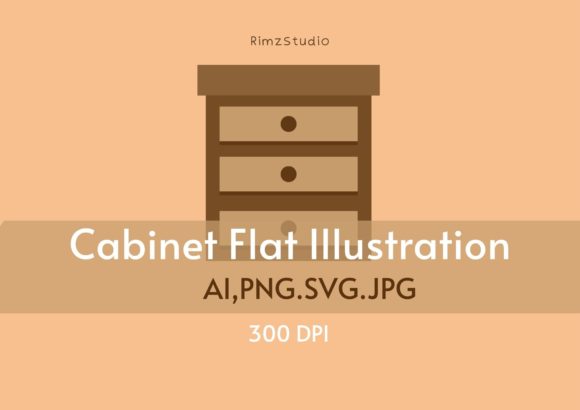
Elevate Your Designs with Cabinet Flat Illustration
In the fast-paced world of digital design, clarity often wins over complexity. Designers, marketers, and content creators are constantly searching for visual assets that communicate ideas instantly without cluttering the user interface. This is where the Cabinet Flat Illustration shines. It is more than just a decorative element; it is a versatile vector tool designed to streamline workflows for web design, mobile apps, and creative campaigns. Whether you are building a landing page for a tech startup or designing an editorial layout for a lifestyle blog, this graphic style offers the perfect balance of professionalism and approachability.
The appeal of flat illustration lies in its simplicity. By stripping away unnecessary gradients, shadows, and three-dimensional effects, flat design focuses on the core message. A cabinet illustration, specifically, evokes themes of storage, organization, security, and home life. When rendered in a flat style, these concepts become universally understandable across different cultures and devices. For UI designers, this means faster load times and cleaner code. For marketers, it translates to visuals that grab attention without overwhelming the viewer.
Why Vector Assets Matter for Modern Projects
The foundation of any high-quality design project is the file format. The Cabinet Flat Illustration package typically includes SVG, PNG, JPG, and AI files, each serving a distinct purpose in your creative toolkit. Understanding how to leverage these formats is crucial for maintaining quality across various platforms.
The SVG (Scalable Vector Graphics) file is perhaps the most valuable asset for web and app developers. Because it is code-based, an SVG remains crisp and clear regardless of how much you scale it. You can place this illustration on a massive billboard or a tiny mobile icon, and the lines will remain sharp. This scalability is essential for responsive design, where elements must adapt to screens ranging from smartwatches to 4K monitors.
For those working in print or needing quick previews, the PNG and JPG files included in the download are ready to use at high resolution (300 dpi). These are ideal for social media posts, email newsletters, or printed flyers where vector editing isn't necessary. Meanwhile, the AI (Adobe Illustrator) file offers full editability. If your brand colors are specific hex codes rather than standard palette shades, the AI file allows you to tweak every node and color stop, ensuring the illustration matches your brand identity perfectly.
Creative Applications Across Industries
The versatility of a cabinet illustration extends far beyond simple decoration. Different industries can interpret and utilize this graphic in unique ways to solve specific communication challenges.
- Tech and SaaS: In the software industry, a cabinet often symbolizes data storage, cloud servers, or file management systems. A flat illustration of a server cabinet can simplify complex technical concepts for a non-technical audience on a landing page.
- Home and Lifestyle: For interior design blogs or furniture e-commerce sites, this graphic serves as a direct representation of product categories. It can be used as a category icon, a banner header, or part of a larger scene depicting a cozy living space.
- Education and Training: Educators creating digital courses can use cabinet graphics to represent "modules," "libraries," or "resources." The clean lines help students focus on the content rather than getting distracted by overly busy visuals.
- Corporate and Finance: Filing cabinets are synonymous with organization and record-keeping. Financial advisors or legal firms can use these illustrations to convey trust, security, and order in their presentations and brochures.
Adapting Styles for Different Audiences
One of the greatest strengths of flat illustration is its adaptability. While the base geometry remains consistent, the styling can be shifted to match the tone of your project. Since the source files are editable, you have the freedom to experiment.
For a playful and youthful audience, consider boosting the saturation of the colors. Bright yellows, teals, and corals can make the cabinet feel like a toy or a piece of modern pop-art furniture. This approach works well for children's apps, gaming interfaces, or creative agency portfolios.
Conversely, for a corporate or luxury audience, a muted palette often works best. Desaturated blues, greys, and earth tones convey sophistication and stability. In this context, the cabinet illustration acts as a subtle background element that supports the text without competing for attention. The key is consistency; once you choose a color direction, apply it across all your visual assets to build a cohesive brand experience.
Practical Tips for Integration
Integrating stock illustrations into your workflow should feel seamless, not forced. Here are some practical strategies to ensure your use of the Cabinet Flat Illustration enhances your project:
- Maintain Visual Hierarchy: Ensure the illustration supports the primary call-to-action or headline. If the image is too dominant, it may distract users from converting. Use whitespace effectively to let the graphic breathe.
- Check Contrast Ratios: When placing the illustration on colored backgrounds, verify that there is enough contrast for accessibility. Flat designs rely heavily on color blocks, so poor contrast can make elements disappear for users with visual impairments.
- Combine with Other Elements: Don't be afraid to mix the cabinet graphic with other flat elements like people, technology icons, or abstract shapes. Creating a custom scene can tell a richer story than a single isolated object.
- Optimize for Performance: Even though vector files are lightweight, always compress your assets before uploading them to a live website. Use the SVG for the web version to keep page load speeds fast, which is a critical factor for SEO and user retention.
From Concept to Final Product
The journey from downloading a graphic to seeing it live on a successful campaign is where the real value lies. Imagine a freelancer pitching a new branding package to a local storage facility. By taking the editable AI file, recoloring the cabinet to match the client's logo, and placing it prominently on a mock-up landing page, the freelancer demonstrates immediate value and understanding of the client's needs.
Similarly, a blogger writing an article about decluttering can use the PNG version as a featured image. The clean, organized look of the flat cabinet reinforces the article's theme visually before the reader even scans the first sentence. These small touches elevate the perceived quality of the content.
It is also worth noting the potential for sublimation and physical products. Because the files are high-resolution, creators can transfer these designs onto mugs, tote bags, or stickers. This opens up revenue streams for hobbyists and small business owners who sell merchandise alongside their digital services.
Keeping Your Design Fresh and Original
While flat design is a popular trend, it risks becoming generic if everyone uses the same assets in the same way. To keep your work original, focus on composition and context. Instead of dropping the cabinet illustration into the center of a white canvas, try cropping it, rotating it, or layering it behind text masks. Use the graphic as a texture or a repeating pattern rather than a standalone hero image.
Furthermore, stay updated on how flat design evolves. Modern flat design often incorporates subtle textures or micro-interactions. If you are using the SVG on a website, consider adding a hover effect that slightly shifts the cabinet's position or changes its color. These dynamic interactions engage users and make static graphics feel alive.
Ultimately, tools like the Cabinet Flat Illustration are enablers of creativity. They remove the barrier of having to draw everything from scratch, allowing you to focus on strategy, storytelling, and user experience. By understanding the technical capabilities of the files and the semantic meaning of the imagery, you can deploy these assets to create work that is not only visually appealing but also functionally effective.
Whether you are a seasoned designer looking to speed up your workflow or an entrepreneur building your first website, embracing versatile vector elements is a smart move. Keep experimenting with different layouts, color palettes, and combinations. The best designs often come from taking a standard element and pushing it slightly outside its expected boundaries. Thank you for exploring the possibilities of flat illustration; keep checking back for more graphics that can fuel your next big idea.